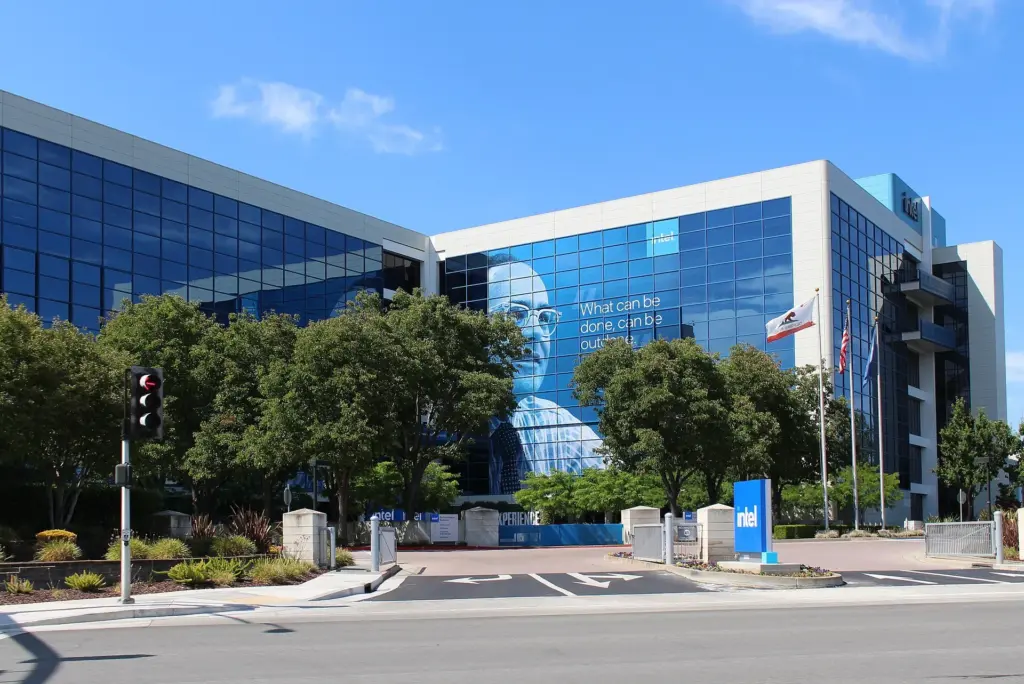
Intel closed at $120.23 on September 30, up $4.30, or 3.71%, and at 9:05 a.m. ET on October 1 it was at $118.71 in the premarket, down 1.26%, on Nasdaq. Between those two prints, TIME published the transcript of a September 28 White House interview in which President Donald Trump called Intel “the hottest stock there is, just about. Right at the top,” said the United States had “made $60 billion” on the stake and then “like $60 or $70 billion,” and, asked why the government would not take the same kind of holding in OpenAI and Anthropic, answered, “I might.” The 3.7% was already on the tape before the transcript existed as a public document. The publication itself, measured before the opening bell, took the shares down about $1.52.
When I marked the 433.3 million shares in Intel’s August 22, 2025 announcement to Wednesday’s close, the contractual maximum came to $52.1 billion. The cost in that announcement was $8.9 billion, at $20.47 a share. The unrealized gain is about $43.2 billion, roughly 487% above the purchase price. A $60 billion profit on that share count needs a price near $159, which is above the top of the $32.89 to $142.35 range Investor’s Business Daily carried on its October 1 quote sheet. Even a generous reading, in which “made $60 billion” means the stake is worth $60 billion rather than that the profit is $60 billion, still asks for about $138.50. Wednesday’s mark is $52.1 billion. The boast describes a stock that has had a remarkable year. It does not describe the position as of the close Trump’s interview met.
Quick take. The year’s move is real: from the April 1 close of $48.03 to $120.23, Intel is up 150%, and IBD puts the year-to-date gain at 225.83%. The morning’s move is the premarket, down 0.6%. The average analyst target on StockAnalysis, shown against the $120.23 close, is $116.37, about 3.2% lower. That is the numbered “might” sitting under the slogan.
Key facts
- $120.23 close on September 30, up $4.30 or 3.71% from $115.93. October 1 premarket, 9:05 a.m. ET: $118.71, down 1.26% — Nasdaq
- “The hottest stock there is” and “I might” on stakes in OpenAI and Anthropic — TIME transcript, published October 1, 2026, interview conducted September 28
- 433.3 million shares at $20.47, an $8.9 billion investment described at the time as 9.9% — Intel announcement, August 22, 2025
- $52.1 billion value of that share count at $120.23, and about $43.2 billion of unrealized gain — FinanceFeeds calculation
- $159 is the approximate price at which the profit on the announced share count would be $60 billion. IBD’s published 52-week high is $142.35
- $116.37 average analyst target, 3.2% below the September 30 close — StockAnalysis
- $140.94 highest close from April 1 through September 30, on June 22, which is 17% above $120.23 — Nasdaq daily closes
- Market value about $636 billion at Wednesday’s close. Wednesday’s $4.30 added roughly $23 billion of market value on 5,286.1 million shares — Investor’s Business Daily
What he said, and which session it landed in
The transcript TIME posted on October 1 is of a September 28 conversation. The Intel passage is a defence of the 2025 deal, not a new transaction. Trump’s account is that Lip-Bu Tan came in with a problem, that the president asked for 10% “not me, the United States of America,” and that Tan said there was a deal. “After that was done, the deal was done, the stock went through the roof, you know.” Pressed on the result, he said, “I think we made $60 billion.” Asked why the same idea would not be applied to OpenAI and Anthropic, he said, “I might. Maybe I could do that.” A few lines later the figure became “like $60 or $70 billion,” and then the line that will travel: “Intel’s the hottest stock there is, just about. Right at the top.”
The same answer folds in Nvidia. “I told Jensen that a chip that he’s not allowed to sell, which I think is okay to sell, but I won’t let him sell it unless he gave the United States of America a cut.” That is an export-licence argument sitting inside an Intel answer.
The tape does not line up with “published today, therefore up 3.7%.” Wednesday’s regular session, the 3.71% to $120.23, ran from a $116.22 open to a $120.55 high and a $116.00 low, on 94.9 million shares. IBD’s 50-day average volume is 109.3 million, so the session was busy and short of a blow-off. TIME’s transcript went up on Thursday morning. At 9:05 a.m. ET the premarket was $118.71. Anyone who bought the close because of a story they had not yet read was already $1.52 underwater before the bell.
Nor is $120.23 a high that the interview is celebrating in real time. Nasdaq’s closes show September 24 at $127.39, September 25 at $123.00, September 28, the day of the interview, at $116.03, and September 29 at $115.93. Wednesday’s bounce recovered $4.30 of a $11.46 slide from the September 24 close. The stock finished that stretch 5.6% under $127.39. The 12% single-day gain FinanceFeeds reported, to $121.78 on September 21, is the neighbourhood Wednesday returned to, after a round trip through $127. That day was about CPU demand and Lip-Bu Tan’s comment that Intel could meet about half of it, covered in Intel rose 12% in a day. It was not this interview.
April 1’s close was $48.03. Wednesday’s $120.23 is 150% above it, and IBD’s year-to-date figure is 225.83%. From the government’s $20.47 the shares are up about 487%. “Hottest” describes that rerating. The publication morning was a 1.26% premarket decline.
The stake, marked to $120.23
Intel’s announcement of August 22, 2025 is the document the profit claim has to survive. The government agreed to purchase 433.3 million primary shares at $20.47, funded by $5.7 billion of unpaid CHIPS and Science Act grants and $3.2 billion from the Secure Enclave program, $8.9 billion in total, and Intel called that 9.9% at the time. The stake is passive. There is no board seat and no information right. The government votes with the board, with limited exceptions. A five-year warrant at $20 covers a further 5% and can be exercised only if Intel ceases to own at least 51% of the foundry business. Chief executive Lip-Bu Tan said in that announcement: “We are grateful for the confidence the president and the administration have placed in Intel, and we look forward to working to advance US technology and manufacturing leadership.”
At $120.23, 433.3 million shares are worth $52.10 billion. Subtract the $8.87 billion implied by 433.3 million times $20.47, and the gain is $43.2 billion. Trump’s “$60 billion” is about $17 billion above that gain. His “$60 or $70 billion” tops out about $27 billion above it. The price that makes a $60 billion profit true is about $159. IBD’s 52-week high of $142.35 would put the same share count near $61.7 billion of value and about $53 billion of profit. The June 22 closing high in the Nasdaq series, $140.94, is the same neighbourhood, about $61.1 billion of value. The claim is not true at any price Intel has traded in the past year, if “made” means profit. It was briefly in range of a $60 billion value in late June, and it is not there now.
The 9.9% is also a 2025 percentage. IBD lists 5,286.1 million shares outstanding. Divided into that count, 433.3 million shares are 8.2% of the company, and only if every one of them is outstanding. FinanceFeeds’ reading of the June 27, 2026 balance sheet, in the High-NA foundry piece, found 143 million shares still escrowed. Later release would close that gap. It does not turn $43 billion of gain into $60 billion. Wednesday’s $4.30, on those 5,286.1 million shares, added about $23 billion of market value in one session, which is more than half the government’s entire paper profit. That is how large the equity has become relative to the cheque that bought the stake.
Nvidia’s disclosed Intel position, 214.8 million shares in the June 30 13F that FinanceFeeds marked up in September, is worth about $25.8 billion at the same close, about half the government’s contractual maximum. The government’s entry, at $20.47, is the better one, and it is the one the transcript prices at $60 billion to $70 billion of profit. The gap at Wednesday’s close is about $17 billion.
What Intel has said, and what “I might” refers to
By the 9:05 a.m. premarket print, Intel had not issued a statement on the interview. The standing sentence on the stake remains Tan’s from August 2025. Confirming “$60 billion” would adopt a profit the share count does not produce. Correcting it would mean arguing with the holder. The wires carried neither.
The “I might” is the forward-looking half of the answer, and it is aimed at OpenAI and Anthropic, not at a larger Intel stake. Trump has said before, including to Fortune in May, that he should have asked Intel for more. Thursday’s transcript does not raise the Intel percentage. It offers the Intel deal as a template for two private labs. The template does not transfer. Intel had unpaid CHIPS Act and Secure Enclave funds that could be converted into shares of a company that already traded, at a discount to a market price, with a warrant tied to keeping the foundry. OpenAI and Anthropic do not have an equivalent unpaid grant sitting at Commerce. Anthropic’s IPO filing, reported by Reuters the same morning, is a confidential prospectus seeking a valuation of about $2 trillion, full of commercial conflicts with Amazon, Google and Broadcom. A government shareholder would be one more related party that prospectus would have to disclose. “I might” is not that disclosure.
FinanceFeeds’ companion piece, Broadcom’s $42 billion lending ceiling for Anthropic, is the commercial version of the same morning: a supplier offering to finance, and possibly own equity in, the lab. A federal stake on top of a supplier’s convertible would stack two non-operating holders onto a company whose prospectus already warns that its compute access depends on counterparties who are also investors. Nothing in the TIME transcript says that structure has been proposed to either lab. The sentence is “I might. Maybe I could do that.” Deal lawyers do not book a position on that syntax. Equity desks, on the evidence of a 1.26% premarket decline, did not either.
The transcript opens with TIME asking about a dinner the night before with “Dario,” in a run of questions about AI safety. Anthropic’s chief executive is Dario Amodei, and he was at the White House the next day. The dinner and the “I might” are a few lines apart. Anthropic had already declined to comment on its Broadcom disclosure that morning. None of that is a term sheet.
A public stake and a private one are different instruments
The regulatory object in Intel is settled and narrow. Grants that had been awarded and not fully paid became common stock. Clawbacks and profit-sharing on the CHIPS money already disbursed were removed, on the company’s account, to make the capital permanent. The holder has no board seat. The warrant exists to penalise a loss of foundry control, not to give the government a second bite at today’s price. That is industrial policy executed as a buy order in a listed name, and the buy order has worked on the only measure that matters to the seller of the shares: $20.47 went to $120.23.
A stake in OpenAI or Anthropic would be a different statute-free negotiation with a private company that has other large shareholders and, in Anthropic’s case, an IPO document already in front of the SEC’s process. The government’s Intel shares are marked every afternoon. A pre-IPO stake is marked when someone says it is, which is how a $60 billion sentence can outrun a $52.1 billion position by an afternoon. Extending the method to labs whose valuations are set in private rounds, Anthropic’s reported aim is about $2 trillion, would produce a public number only when the holding was disclosed. Until then the only listed equity a desk can trade on the comment is Intel, and Intel’s premarket said the comment was not new demand.
The Intel deal converted money Congress had already directed at domestic manufacturing. A discretionary equity bite of a frontier lab, taken because that trade worked, is a different act: the state as a venture investor in the companies that buy the chips. The Nvidia line in the same answer, a cut of restricted chip sales, is a third tool. Only the Intel certificate has a last sale, and that sale is $120.23.
Intel’s other public equity mark is the 49% of Altera carried at $3.2 billion in the June quarter, now in a confidential IPO, covered in Altera’s filing. That is a carrying value the company has published. The government’s Intel holding is the one a president priced, verbally, at $60 billion to $70 billion of profit against a Wednesday mark of $52.1 billion of value and $43.2 billion of gain.
Where $120 can go from here
Three figures bracket the next move, and none of them is another 3.7% gifted by an adjective.
The first is the Street’s. StockAnalysis shows an average target of $116.37 against the $120.23 close, 3.2% lower, about $3.86 a share. IBD lists earnings for October 22. If the quarter does not convert the CPU shortage Tan has described into revenue and margin, the path back through Wednesday’s $4.30 is the one the average target already points at. The premarket gave back $1.52 of it with the transcript about two hours old. A target under the price is the market’s way of saying the hottest-stock year is in the chart, and the next dollar is not assumed.
The second is a retest of prices the stock has already printed. The June 22 close of $140.94 is 17% above $120.23. IBD’s 52-week high of $142.35 is 18% above it. Both are inside the year. Neither makes the $60 billion profit true. Getting the profit claim to match the share count takes about $159, which is 32% above Wednesday’s close and outside the 52-week range. I would not underwrite that price off a magazine interview. It is the level at which the sentence becomes arithmetic, and it is useful because it is specific.
The third is the desk’s existing frame. On September 27 FinanceFeeds published a $172 bull case and a $74 bear case against a spot of $123, about 43% above and 38% below Wednesday’s close. The bull case still needs a named external foundry customer. The bear case needs the multiple to come in. A description of the stock, and a hypothetical stake in two labs, changes neither. The measurable reaction is 3.71% on Wednesday and 1.26% the other way before Thursday’s open. The $17 billion gap between “we made $60 billion” and a $43.2 billion gain is the figure a holder can verify before October 22.
FAQ
How much did Intel stock move?
Intel closed at $120.23 on September 30, up $4.30, or 3.71%, from $115.93. At 9:05 a.m. ET on October 1, after TIME published the interview, Nasdaq showed a premarket price of $118.71, down 1.26%. The 3.7% session happened on Wednesday. The transcript was published Thursday morning. From the April 1 close of $48.03, the stock is up 150%.
Did Trump call Intel the hottest stock?
Yes. In the TIME transcript published October 1, of an interview conducted September 28, he said, “Intel’s the hottest stock there is, just about. Right at the top.” In the same passage he said the United States had made $60 billion on the stake, and then “like $60 or $70 billion.” Investor’s Business Daily’s October 1 sheet shows a year-to-date gain of 225.83%.
How much is the US Intel stake worth at $120?
Intel’s August 22, 2025 announcement covered 433.3 million shares at $20.47, an $8.9 billion investment then described as 9.9%. At Wednesday’s $120.23 close that share count is worth $52.1 billion. The unrealized gain is about $43.2 billion. A $60 billion profit would require a share price near $159, above the $142.35 high on IBD’s 52-week range.
Is the government buying OpenAI or Anthropic?
The transcript records a question about doing the Intel deal with OpenAI and Anthropic, and the answer “I might. Maybe I could do that.” There is no term sheet, percentage or price in the interview. Intel’s deal converted unpaid CHIPS Act and Secure Enclave funds into listed shares. Those two labs do not have that unpaid grant, and Anthropic’s IPO filing, as Reuters reported the same morning, does not disclose a government shareholder.
What could move the share price next?
The average analyst target compiled by StockAnalysis is $116.37, about 3.2% under $120.23. The June 22 closing high of $140.94 is 17% above Wednesday’s close. IBD lists an earnings date of October 22. FinanceFeeds’ September 27 scenarios, a $172 bull case and a $74 bear case, still depend on a named foundry customer and on the multiple, not on a description of the stock.
Did Wednesday’s 3.7% come from the TIME interview?
The interview was conducted on September 28 and the transcript was published on October 1. Wednesday’s regular session was finished before that publication. The premarket after publication was down 1.26%. September 24’s close was $127.39, so Wednesday’s $120.23 was a bounce inside a pullback, not a new high made on the headline.